The Frame Has an Outside: What Cropping Makes Us Notice
Learn how screen-image cropping directs attention, what lies beyond the frame, and how to distinguish visible evidence from assumptions about omission.
Cropping directs attention by deciding which parts of a scene remain visible. In a screen image, the frame gives a face, doorway, or hand a clear place to draw the eye, while everything beyond its edges becomes unavailable as direct visual evidence. That boundary shapes interpretation, but it does not tell us why the image was framed that way.
This distinction matters when reading a film scene, a television shot, a video call, or a still image. You can describe what the frame makes prominent and consider what it leaves out without turning absence into proof of a creator’s intention.
What does cropping change in a screen image?
Cropping changes the visible field: it removes information from one or more edges, or selects a smaller portion of a larger image. The subject may stay the same, but its relationship to its surroundings changes. A close view of a person can make an expression easier to notice while withholding the room, other people, and the activity around them.
In moving images, framing is not always a crop applied after filming. A camera operator can choose a tight view while recording, and an editor can select among recorded views. A screen may also display only part of an image made for a different shape. These situations produce a similar boundary for the viewer, though the production choices behind them differ.
The frame also creates a hierarchy. A face near the center or in sharp focus may seem more important than a dim object near the edge. But salience is not the same as meaning: an object can be easy to see without being symbolically significant, and a partially visible detail may be incidental.
How does the frame guide attention?
Viewers tend to notice features that stand out from their surroundings. Brightness, contrast, color, sharpness, size, movement, and placement can all influence where the eye goes. A sharply lit hand against a dark coat may attract attention before the background does. A face turned toward the edge can also encourage the viewer to look in that direction, even when the object of the person’s gaze remains outside the image.
The frame works together with composition rather than acting alone. A doorway can divide the image into spaces; a line of furniture can lead the eye toward a seated figure; a shallow focus can soften what is behind the subject. Cropping determines which of these cues are available to the viewer, while lighting and arrangement affect the relative weight of what remains.
Context changes what a crop seems to emphasize. A tight shot of someone listening may register as intimacy in one scene and scrutiny in another. The surrounding action, sound, dialogue, and neighboring shots help establish the difference. A still image, detached from its sequence, may leave those cues unavailable.
What can we infer from what is outside the frame?
We can infer possibilities, not confirm unseen details from the border alone. If a character looks offscreen, the gaze suggests that something may be beyond the image, but it does not identify what that is. If a room is shown only in close-up, we can say the room’s wider layout is withheld from view; we cannot conclude that the camera is concealing a particular person or object.
That distinction keeps visual analysis grounded. Separate three observations:
- Visible: What can be described directly, such as a face, a strip of wall, or a hand at the edge.
- Implied: What the image suggests, such as a person looking toward something beyond the border.
- Unknown: What the image does not establish, such as the identity of the unseen object or the reason it is absent.
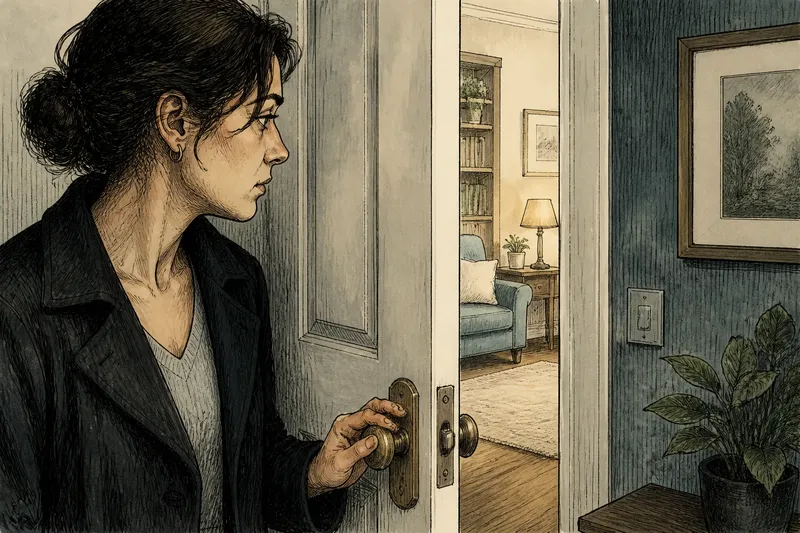
Say you are watching an invented scene in which a woman stands beside a half-open door. The image shows her face and one hand on the handle, but not the room beyond. You can observe her pause and the narrow opening; you might infer hesitation from the pause, depending on the scene’s other cues. You cannot claim that someone is hidden in the room unless the work supplies further evidence. The useful result is a precise reading of what the crop supports, not a guess presented as fact.
Does an offscreen space always imply deliberate concealment?
No. A detail outside the image may be omitted because of the camera position, the shape of the display, the needs of a conversation, or the practical limits of the shot. It may also be excluded to direct attention or preserve suspense. The frame alone cannot tell us which explanation applies.
Even an effect that feels purposeful can have more than one cause. A narrow composition may make a setting feel cramped, but it could also reflect the available camera position or the format in which the image is being shown. Describe the effect first. Treat a claim about intent as a possibility that needs support from other evidence, such as repeated framing choices or a clear pattern in the scene.
It is not worth assigning a secret meaning to every cropped edge. If the visible details do not support a useful interpretation, record the limit and move on. Restraint is not a failure to read the image; it is part of reading accurately.
How can you tell a crop from a camera’s original framing?
Often, you cannot tell from a single image. A still may have been composed for its current dimensions, trimmed later, or fitted to a screen that displays a different shape. Black bars, a sudden shift in image dimensions, or a comparison with another version may offer clues, but none automatically reveals the whole production history.
When comparing versions, look for changes at the edges: a shoulder that appears in one version but not another, a sign cut off in one display, or a wider strip of background. Keep the comparison modest. A wider image shows more of the recorded scene, but it does not necessarily show everything that happened beyond the camera’s view.
For moving images, notice whether the frame stays fixed or changes during the shot. A pan, tilt, or camera movement can reveal space that was previously outside the image. That reveal confirms what enters the frame at that moment; it does not establish what was present beyond the scene before or after it.
What should viewers ask about the frame?
What is the crop making easiest to notice?
Name the most prominent visible feature and the cues that make it stand out, such as focus, brightness, or placement. This answers what the image emphasizes without assuming why.
What relevant context is missing?
Identify the kind of information the border withholds: the room’s layout, another person’s reaction, or the object a character may be watching. Keep the description specific, and do not replace missing context with an invented fact.
What supports an interpretation beyond the crop?
Look to nearby action, sound, dialogue, and other shots for evidence. If they do not clarify the unseen space, leave the question open rather than treating an omission as a confirmed message.
These questions make cropping easier to discuss in concrete terms. They also help distinguish a formal effect from a claim about motive. The image can make an absence noticeable without telling us whether that absence was planned, meaningful, or simply outside the camera’s view.
How should a viewer describe a crop precisely?
Start with location and extent: say that a figure is cut off at the shoulder, that the top of a doorway falls beyond the image, or that the shot excludes the far side of a table. Then describe the effect in qualified language: the tight framing keeps attention on the speaker’s expression, or the missing background leaves the setting unclear.
When discussing cropping, these phrases preserve the difference between observation and interpretation. “The shot excludes the other chair” is a visible fact. “The director wants us to suspect a hidden guest” is a claim about intention, and it needs evidence beyond that excluded chair.
The frame has an outside, but its border is not a transparent account of why anything lies there. Read what is included carefully, name what is unavailable, and let the surrounding scene support any further inference. That approach makes screen-image analysis more exact without making it less curious.